

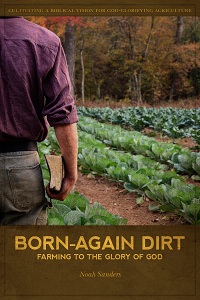
I am a very passionate promoter of Christian agriculture. I love farming. I believe that it is something God calls His people to (in a general sense, not every individual) and that it provides the opportunity for an integrated lifestyle of worship, work, family, and ministry. This is part of the message of my book, Born-Again Dirt, and since writing it I have talked to many, many Christians who are beginning to care for and work the land to some degree or another. I am very excited about the work the Lord is doing in the hearts of His people to give them a desire for taking back creation stewardship for His glory.
Recently, however, the Lord has begun to show me some of the dangers and traps associated with Christian agriculture. As with most anything in life, we can so easily take things that are good and run with them until we take our eyes off of Christ and fall off the straight path. So in this post I want to briefly share a few ‘dangers’ I think we should guard against as born-again farmers:
1. Pride in Living a “Superior Christian Life”
Farming does not automatically make us better Christians. Indeed, there are many benefits to the lifestyle of agriculture that can help facilitate Christ-centered living, but farming itself is not some higher Christian calling that takes us to the next level spiritually. I have even heard of stories where, when not done prudently, returning to the land and homesteading has torn families apart. Farming is something that we must do because that is what God has called us to, not because we think it will fix all our problems and make us happy. Because I love farming and am passionate about sharing the glories and benefits of it, even comparing it with other occupations, I have to guard against causing other brothers and sisters in Christ to feel inferior because they don’t farm. “May I never boast except in the cross of our Lord Jesus Christ, through which the world has been crucified to me, and I to the world.” Galatians 6:14
2. Trust in Self and Self-sufficiency
One of the attractions of farming is that it allows us to work for ‘ourselves’, and have more control over what we do and how we spend our time. It also allows us to produce a lot of what we need for ourselves (in terms of food and fuel) and be less dependent on buying things from others. However, while we are enjoying trying to be a have a more sustainable and self-sufficient farm we can easily fall into the trap of individualism, selfishness, and isolationism. And sometimes, while we may not be doing it as individuals, we may be guilty of doing it as a family. We need to realize that one of the main goals of our pursuit of sustainability and individual/family agrarian productiveness is not so we don’t have to rely on others, but rather so that we can be in a position to help “carry each other’s burden’s” as God calls us to. God has created us to need one another in the body of Christ. Thus, while it is a good thing to seek to be independent of unbelievers and un-godly systems we must realize that we as Christian believers and families are intended to function together as the body of Christ, needing each other in order to be effective. “The eye cannot say to the hand, “I don’t need you!” And the head cannot say to the feet, “I don’t need you!”" 1 Corinthians 12:21
3. Legalism and Trust in Methods
As ‘born-again’, Christian farmers it is important how we farm because we should recognize that we are accountable to God for how we care for his creation. But we need to guard against becoming too caught up in attaching the name of Christ to any particular method. To be sure, we need to be purposeful that the methods and practices we use honor the Lord, but that doesn’t mean they are the only, or even the best, way for every farm to bring Him glory. If I have found that a particular gardening method is very fruitful and easy, and seems to honor God’s design in Creation, then I can share it with others, but I shouldn’t start telling people, “If you are a Christian, then this is the gardening method you should use if you want God to bless you.” We must beware of developing formulas and falling into legalism where we attribute our farming ‘righteousness’ to a particular set of practices. It is God and God alone who blesses our farms and produces fruit. The way we farm should flow forth from a love for God and a passion to subject everything we do to the authority of Christ. And I don’t think this would result in every born-again farm looking and operating exactly the same way.
4. Becoming a Workaholic
Farming involves a lot of work, as many of us know. If we want God to bless us as farmers we must be diligent in our work. There are animals to feed, weeds to cultivate, barns to build, customers to serve, crops to pick, fences to repair . . . and the list goes on and on. Work is a gift of God and can bring much satisfaction and fulfillment. But farm work, although demanding, is not the only thing God calls us to in life. There are wives to love, children to raise, neighbors to help, messages to write, hospitality to show, fellowship to enjoy, and souls to win. The beauty of farming is that many of these things can be integrated into the life and work of the farm. But I find that they can easily suffer from it as well. I have to remind myself on occasion that my success is not rated by what I can physically achieve in a given day. Let us guard against becoming Christian farm-aholics, and make sure we focus on sowing into the relationships in our lives as well as in our fields.
5. Considering “Simple living” as a Means to Holiness
Many Christians move to the country and take up farming/homesteading because they want to get away from the fast-paced, busy life of the city. The simple life of the farm can help many of us focus on what is really important in life by removing many of the distractions of the modern age. Some of us may even dabble with ‘off-grid’ living. But a danger I would caution us against here is falling into the trap of viewing simple living as a means to holiness. Although there are benefits to being free from some of the luxuries and conveniences of the world, they do not equal righteousness. We are not automatically more honoring to God just because we grow a garden, cut our own firewood, or milk our own cow. Honoring God starts with the heart and those things are merely fruit. Are not many pagans doing those same things today? However, they are often doing it to feel better about themselves, not to honor God.
6. Judging other Farmers we consider “Worldly”
It is very easy, especially as we become more passionate about trying to honor the Lord in the way that we farm, to look down upon what we would consider ‘worldly’ Christian farmers. Many of us have studied, prayed, and been convicted about the way that we farm, but we can subsequently begin to think that anyone who doesn’t farm like we do must not really love Jesus. While it is fine and good to discuss the Biblical merits of this or that farming method, we must be very careful to judge the hearts of other farmers using our own standards. Only God knows the hearts of men. And at whatever point we judge another, we are guilty. Do you farm organically and think that industrial farmers are greedy? Well, since no one on earth is perfect, they probably are. But that same greed lies in your heart too, no matter how you farm. The Christian life is a journey of sanctification. None of us have arrived at a place where we perfectly honor God in our farming. We all have growing and learning and repenting to do. We need to show grace to one another, holding firmly to the truth while guarding against looking down upon brothers or sisters in Christ just because they are on a different part of the journey. Our goal should be to share our testimony of where God has brought us and what he has shown us and encourage each other in the right direction, which is Jesus Christ.
7. Worship of Farming
As with many things in life I can easily allow farming to become an idol in my heart. Because it is such a major part of my daily life and object of my energies, it can quickly consume more of my heart than it should. I love farming! But woe to me if I should allow my care for the land to become my focus rather than my commitment to Christ! Agriculture should not be the center of my life, Christ should. Do I feel more of a bond with a fellow farmer than I do with a fellow follower of Jesus? Am I more willing to stand up for good farming stewardship than for the Gospel of Christ? That should give me a clue as to where my heart really lies. And cause me to fear. May I seek first the Kingdom of God. We as Christians should be some of the most passionate farmers in the world. Not because we just really, really love to get our hands dirty. But because we fiercely love the Savior of our souls and Creator of the world and farm wholeheartedly for Him.
Like this:
Like Loading...